👑 Emperor’s Dream
⚔️ Powers & Ghost Army
🚪 Door God Tradition
🎭 Nuo Ritual Masks
🎮 Black Myth Adaptation
📌 Key Takeaways (TL;DR):
- Who He Is: Zhong Kui (钟馗) is the legendary Taoist King of Ghosts (鬼王) and Grand Demon Vanquisher (赐福镇宅圣君), revered across Chinese culture as the supreme protector against evil spirits.
- The Origin: A brilliant Tang Dynasty scholar who scored first in the imperial exams, but was denied his title due to his terrifying, ugly appearance—leading to his tragic suicide on the palace steps.
- The Divine Mandate: Moved by his upright righteousness, the Jade Emperor crowned him King of Ghosts, granting him command over 84,000 subdued demon legions in the Underworld.
- The Emperor’s Dream: Emperor Xuanzong of Tang was cured of a fatal fever after dreaming of Zhong Kui eating a palace demon, inspiring master painter Wu Daozi to paint the first protective Zhong Kui portrait.
- Black Myth Hero: Game Science adapts Zhong Kui as the protagonist of Black Myth: Zhong Kui, wielding the Seven-Star Sword and riding the Black Exorcist Tiger across the 18 Courts of Hell.
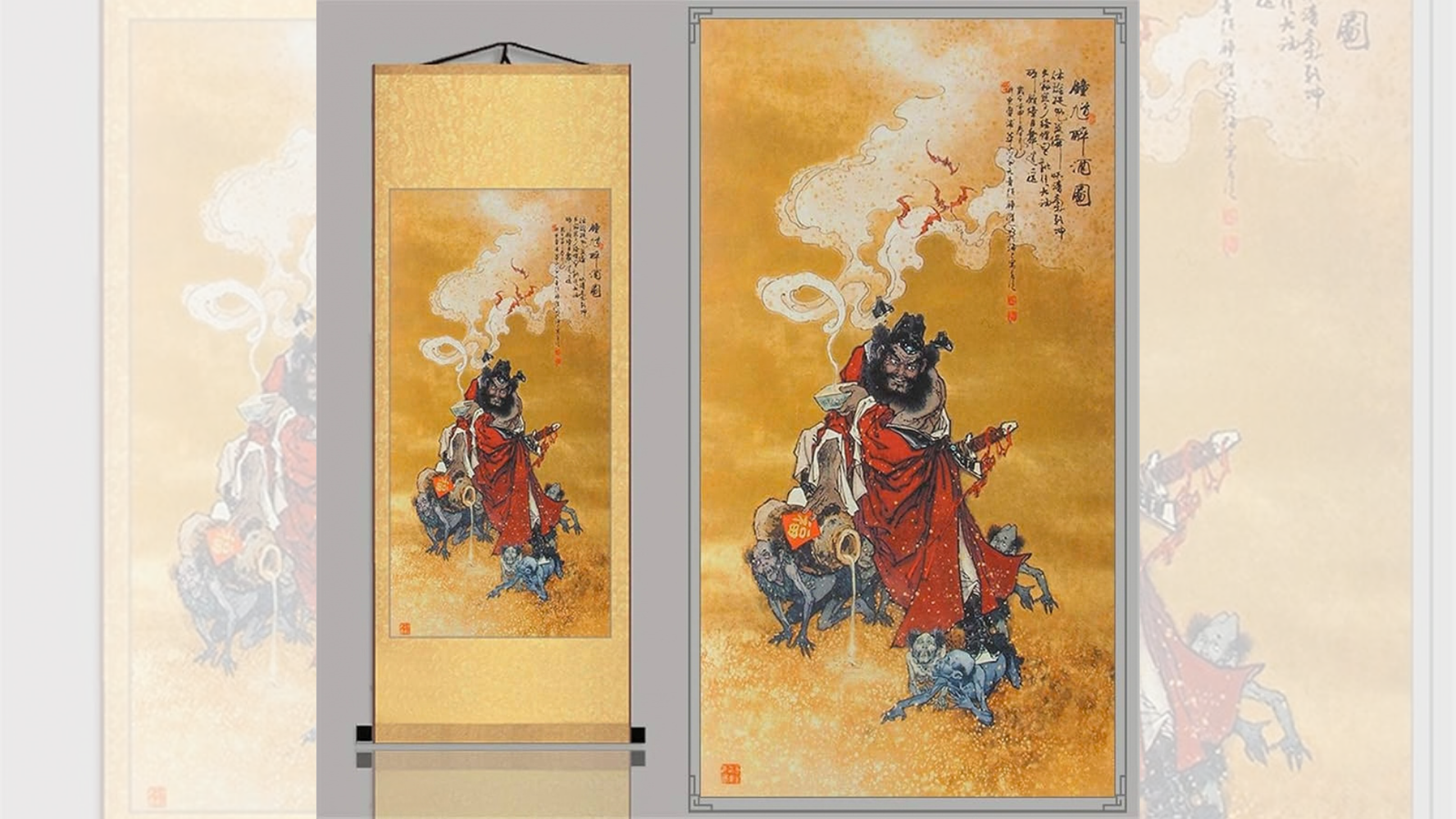
Zhong Kui depicted in traditional classical art: holding his drawn sword with piercing eyes and wild exorcist beard.
If Sun Wukong represents the rebellious spirit of freedom and defiance against celestial authority, Zhong Kui (钟馗) represents the opposite pole of classical Chinese mythology: absolute, incorruptible cosmic justice.
Known variously as the Demon Queller, the Exorcist Deity, and the Grand Master of the Underworld, Zhong Kui is one of the most recognizable and beloved figures in Taoist folklore. His image adorns millions of doors during Chinese New Year and the Dragon Boat Festival, watching over homes to swallow malevolent specters whole.
Here is the full mythological story of Zhong Kui—from his tragic academic origins in the Tang Dynasty imperial palace to his divine role as the commander of the 18 Courts of Hell.
1. The Tragic Origin: The Injustice at the Chang’an Palace Steps
Unlike many mythical deities who were born from celestial stones or dragons, Zhong Kui began his legend as an ordinary mortal man during China’s Tang Dynasty (618–907 AD).
Hailing from the Zhongnan Mountain region (in modern-day Shaanxi province), Zhong Kui was a scholarly prodigy. Possessing vast literary intelligence, military tactical knowledge, and poetic eloquence, he traveled to the imperial capital of Chang’an to sit for the prestigious Imperial Examinations (Keju), the highest test of civil merit in the empire.
⚖️ The Unforgivable Rejection
Zhong Kui ranked first in the empire, earning the coveted title of Zhuangyuan (状元 — Top Imperial Scholar). However, when he was summoned before the Emperor for the formal investiture, the ruler recoiled in disgust. Zhong Kui possessed a naturally fierce, grotesque countenance—a bulging brow, wild curling beard, and towering, intimidating physique. Blinded by superficial vanity, the corrupt imperial court stripped him of his honors on the spot.
Devastated by the corruption of an empire that valued superficial beauty over intellect and righteousness, Zhong Kui hurled his body against the palace stone steps in protest, ending his mortal life. His close scholar friend, Du Ping (杜平), honored his memory by giving him a dignified, honorable burial in a traditional crimson scholar’s robe—a gesture of loyalty that Zhong Kui would repay from beyond the grave.
2. Emperor Xuanzong’s Nightmare & The Legend of Wu Daozi
The turning point that transformed Zhong Kui from a local folk tale into an empire-wide imperial deity occurred during the reign of Emperor Xuanzong of Tang (唐玄宗).
According to the 11th-century historical chronicle Dream Pool Essays (梦溪笔谈) by polymath Shen Kuo, Emperor Xuanzong fell critically ill with a severe, incurable malaria fever. Delirious in his bedchambers, the Emperor experienced a vivid nightmare where two demons invaded his palace:
- A petty demon named Xuhao (虚耗 — “Emptiness and Waste”) had sneaked into the hall, stealing the imperial jade flute and the scented perfume sachet of the Emperor’s favored consort, Lady Yang Guifei.
- As the petty demon mocked the helpless monarch, a towering giant appeared in blue robes and a tattered scholar’s hat. The giant seized the thief, gouged out its eye, tore its demonic body in two, and consumed it whole in a single swallow.
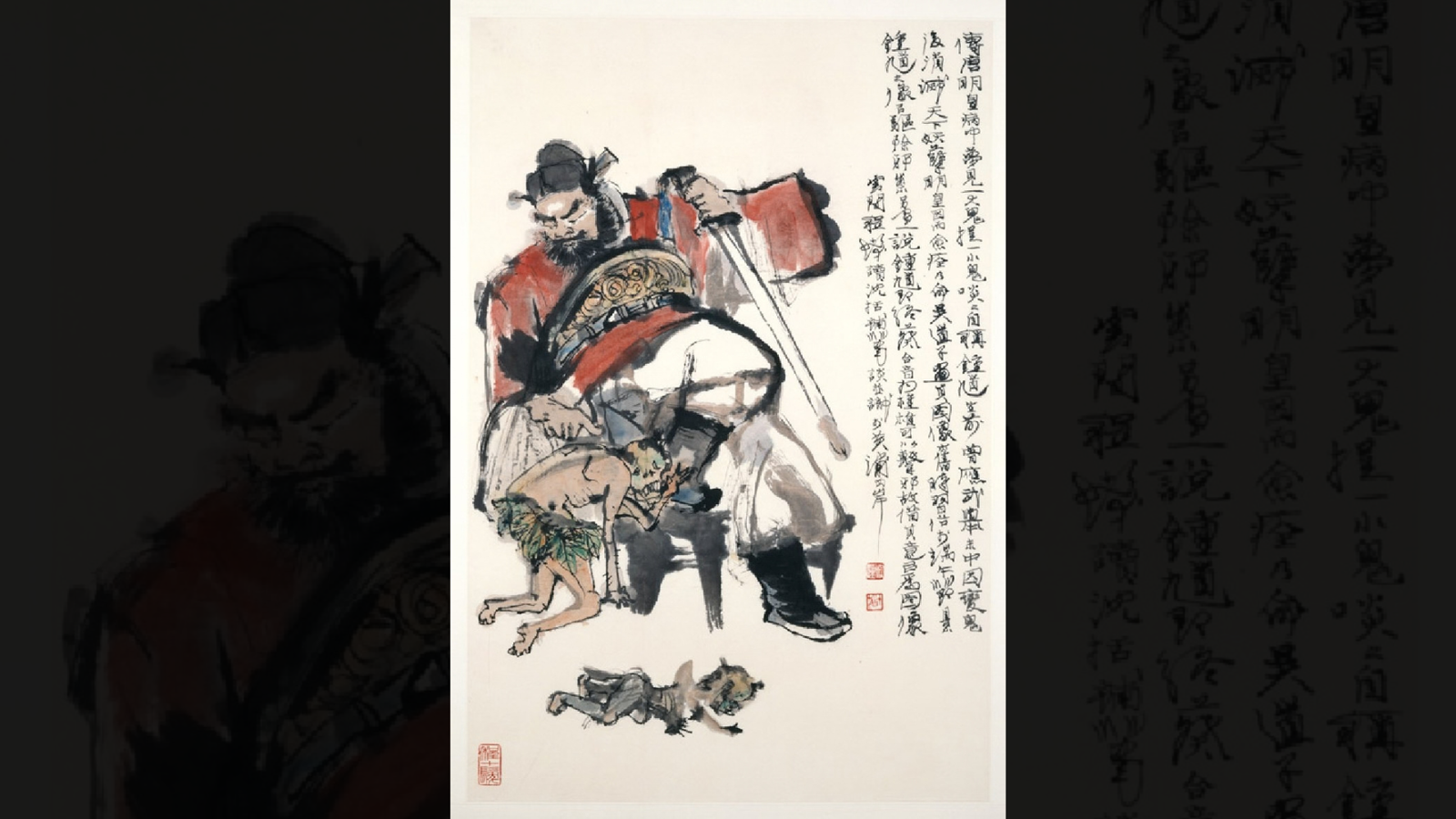
Classical depiction of Emperor Xuanzong’s dream: Zhong Kui confronting the palace demon to cure the imperial malaria.
When the Emperor asked the giant who he was, the spirit bowed and declared: “I am Zhong Kui of Zhongnan Mountain. Having failed the examinations due to my appearance, I vowed to eradicate all pestilence and demons from the realm.”
Upon waking, Emperor Xuanzong discovered his fever had completely broken. Astonished, he immediately summoned China’s greatest court painter, Wu Daozi (吴道子), and commanded him to paint Zhong Kui’s likeness exactly as seen in the dream. The portrait was so lifelike and intimidating that the Emperor ordered copies distributed across every province, establishing Zhong Kui as China’s official protector against disease and evil spirits.
3. The King of Ghosts: Powers, Weapons & 84,000 Spirits
Moved by his uncompromising sense of justice, the Jade Emperor (supreme ruler of the Taoist heavens) elevated Zhong Kui’s spirit into the celestial pantheon, investing him with divine authority over the Underworld as the King of Ghosts (鬼王).
Zhong Kui’s mythological arsenal and powers include:
- The Seven-Star Exorcism Sword (七星斩妖剑): Forged with the astral alignment of the Big Dipper (Ursa Major), this sacred blade severs spectral ties, absorbs demonic fire, and cuts through immortal flesh. Explore the weapon’s gameplay in our Seven-Star Sword Guide.
- Demonic Ingestion (Ghost Devouring): Zhong Kui possesses the unique spiritual ability to swallow malignant wraiths and toxic miasma, converting their demonic energy into righteous Qi.
- The 84,000 Ghost Army: Rather than destroying every spirit, Zhong Kui subdued a legion of 84,000 reformed ghosts. These spirits serve as his heralds, lantern bearers, and scouts across the underworld depths.
- The Black Exorcist Tiger: Zhong Kui rides a ferocious, armored black tiger capable of traversing subterranean abyss chasms and underwater rivers. See our full breakdown in the Mounts & Traversal Beasts Codex.
- Spirit Possession & Talisman Seals: Through Taoist Cinnabar paper seals, he commands giant nether behemoths in combat, a core mechanic featured in our Spells & Summons Codex.
4. Why Zhong Kui is on Chinese Doors: The Men Shen Tradition
For more than a thousand years, Zhong Kui has occupied a central place in folk tradition as a Door God (门神 — Men Shen). During two major cultural festivals, his likeness is displayed on gates and entryways across China, Taiwan, and Southeast Asia:
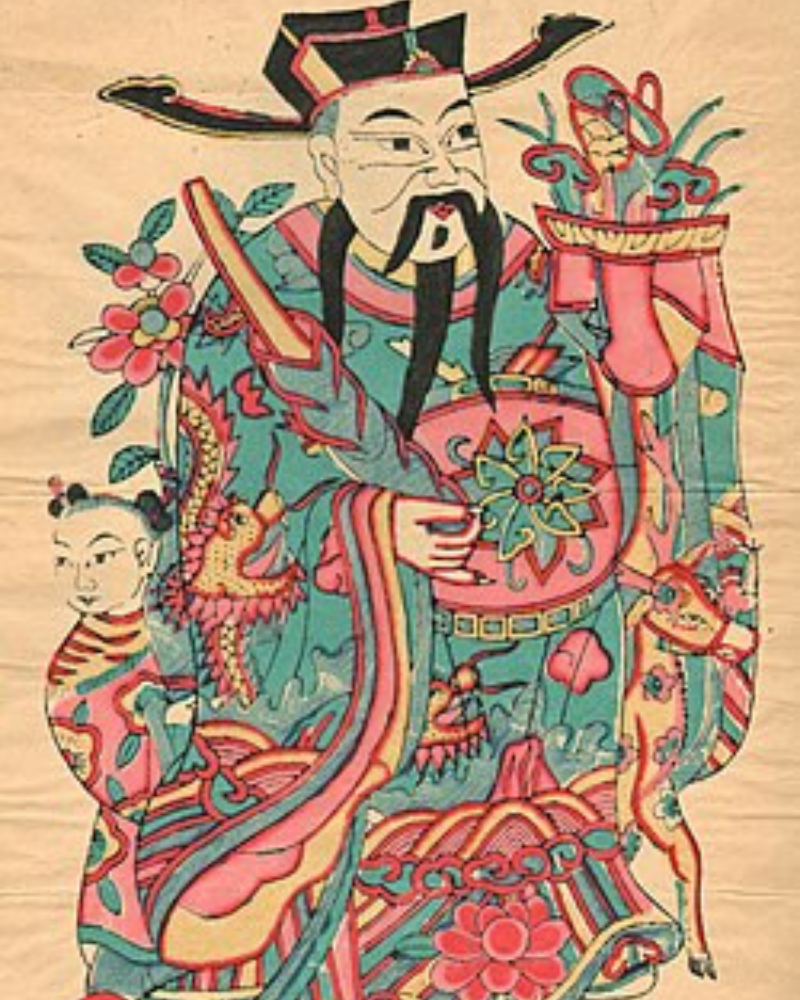
Traditional Chinese New Year woodblock print (Nianhua): Zhong Kui guarding the threshold against malignant spirits.
- Chinese New Year (Spring Festival): Families paste brightly colored woodblock prints (Nianhua) of Zhong Kui holding his sword to prevent wandering malicious spirits from crossing the threshold into the new year.
- Dragon Boat Festival (Duanwu): Because the fifth lunar month is historically associated with summer pestilence, poisonous vermin (scorpions, vipers, centipedes, toads), and disease, Zhong Kui talismans are hung alongside calamus and mugwort to purify the home.
5. Nuo Exorcism Masks: The Ancient Ritual Behind Black Myth
In the opening cinematic of the official 15-minute showcase for Black Myth: Zhong Kui, players see the protagonist sitting solemnly, applying ritual red and white cosmetics to his face before donning a fierce wooden mask.
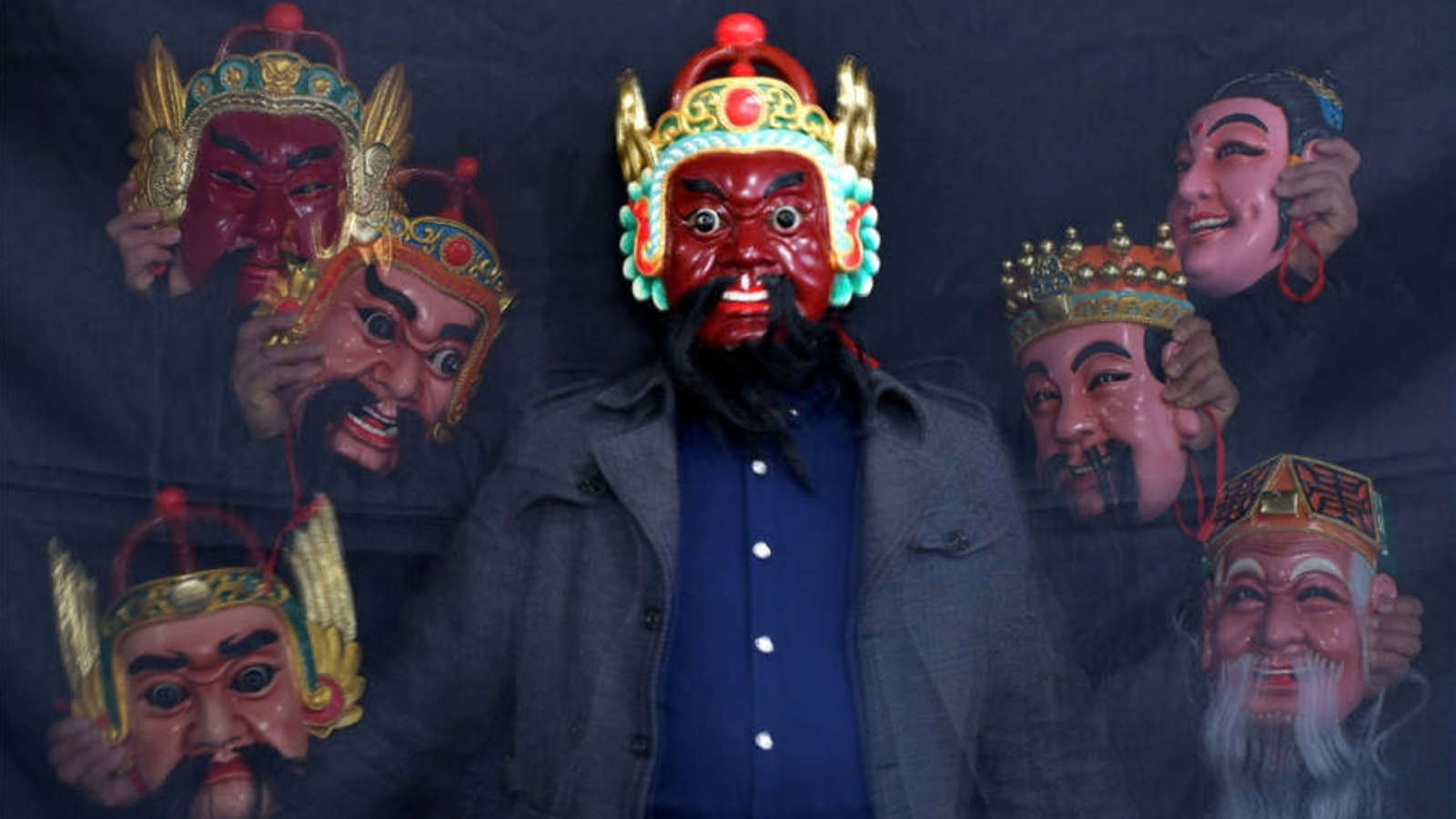
Carved wooden Nuo Opera mask (傩面具): The ancient shamanic exorcism tradition adapted into Black Myth: Zhong Kui.
This is a direct homage to Nuo Folk Opera (傩戏 — Nuoxi), one of China’s oldest continuous religious performance traditions. Dating back over 3,000 years, Nuo rituals involve shamanic dancers wearing intricately carved wooden masks representing fierce guardian deities to drive away demonic influences and plague spirits.
By donning the Nuo mask, Zhong Kui blurs the boundary between mortal scholar and terrifying demon god, allowing him to infiltrate hostile underworld territories without being recognized by corrupt judges.
Zhong Kui Mythology Data & Deity Profile
| Mythological Fact Sheet | |
|---|---|
| Chinese Characters | 钟馗 (Simplified) / 鍾馗 (Traditional) |
| Honorific Title | 赐福镇宅圣君 (Holy Sovereign Who Bestows Blessings & Guards the Home) |
| Realm of Authority | Diyu (The 18 Courts of Hell) & The Mortal Realm |
| Primary Weapon | Seven-Star Demon-Slaying Jian (Sword) |
| Mythic Mount | The Armored Black Exorcist Tiger |
| Subordinate Army | 84,000 Reformed Ghosts and Ghost Soldiers |
6. How Game Science Reimagines Zhong Kui in the Black Myth Universe
In developing Black Myth: Zhong Kui, Game Science takes the historical and folk foundation of Zhong Kui and reimagines it as an intensely visceral action-RPG campaign:
- Righteousness vs. Corruption: Rather than fighting comical cartoon ghosts, Zhong Kui faces the deeply corrupt judicial hierarchy of the Underworld—judges who traffic in mortal souls and colossal Yaoguai such as the Underworld Poison Toad.
- Blade Mastery & Deflection: While Sun Wukong relied on acrobatic staff strikes and rolling, Zhong Kui fights with disciplined, two-handed sword parrying and active blocking. Master the mechanics in our Complete Parry & Block Combat Breakdown.
- Shared Universe Lore: Because both Wukong and Zhong Kui share the same Tang Dynasty setting, the game explores the fallout of Sun Wukong’s legendary invasion of Hell, where the Monkey King erased his name from the Book of Life and Death. Read our full analysis in Is Black Myth: Zhong Kui Connected to Wukong?.
Frequently Asked Questions About Zhong Kui
Why does Zhong Kui eat ghosts?
In Chinese mythology, evil spirits represent spiritual corruption and disease. Zhong Kui’s act of swallowing demons symbolizes the total purification and annihilation of malicious Qi, preventing negative spirits from reincarnating or harming the mortal realm.
Is Zhong Kui a real historical person?
Zhong Kui is primarily a mythological figure born out of Tang Dynasty folk legends and Taoist religious cycles. While he is rooted in the historical setting of Chang’an and the reign of Emperor Xuanzong, there are no official Tang imperial court records verifying his physical existence as a living scholar.
Is Zhong Kui connected to Sun Wukong?
In traditional Chinese literature, they originate from different cycles—Sun Wukong from the Buddhist-Taoist pilgrimage Journey to the West and Zhong Kui from Taoist ghost folklore. However, Game Science connects them under the Black Myth Universe, as both stories take place during the Tang Dynasty and deal with the cosmic bureaucracy of Heaven and the Underworld.
What does Zhong Kui look like?
Zhong Kui is traditionally depicted as a large, formidable man with fierce, bulging eyes, a bushy black beard, and traditional Tang scholar’s robes (frequently colored vermilion or indigo). He is almost always shown carrying a drawn Seven-Star sword or holding a paper talisman.
Explore our complete database of underworld lore, weapons, and demon guides in the 18 Courts Bestiary and Weapons Arsenal at ZhongKuiHQ.com!